Forest Sector Outlook 2026: Weak Demand, Solid Base
The latest forest sector outlook paints a picture of an industry in tension: pressed by a soft near-term market yet underpinned by durable long-term strengths. In its Q2 2026 Forest Sector Outlook, the Global Consulting Alliance — a group of six independent consultancies covering international forestry and wood products, with the quarterly report compiled by Russ Taylor — captured a sector waiting for demand to catch up with its fundamentals.
Forest Sector Outlook: Weak Demand, Strong Fundamentals
The report’s central theme is a split-screen. On one side, cyclical demand is weak; on the other, the long-term fundamentals for wood products remain solid. That combination is familiar to anyone who has watched commodity cycles, but it is especially acute right now as high interest rates weigh on the construction activity that drives so much wood consumption.
Pulling commentary from six consulting firms gives the outlook unusual breadth, spanning North American, European and Asia-Pacific perspectives rather than a single-market view. As Pulp and Paper Canada noted in covering the report’s release, that collaborative structure is designed to triangulate global conditions. The quarterly report is compiled by Russ Taylor, a veteran wood-products market analyst whose forecasts are widely followed across the industry, lending the outlook added weight with mill operators, investors and traders. For readers tracking where prices head next, the outlook complements shorter-horizon reads like the latest Working Forest lumber forecast.
Borrowing Costs and Soft Construction Demand
The clearest drag on the sector is the cost of money. Demand for construction timber, panels and related wood products has continued to be constrained by elevated borrowing costs and subdued residential development across several major economies. When mortgages and project financing are expensive, housing starts slow — and with them the pull-through demand for framing lumber, sheathing and engineered panels.
That dynamic explains why the “weak cyclical demand” half of the report’s thesis dominates the present moment. Builders delay, renovations get deferred, and inventories back up through the supply chain. The silver lining in the outlook is that these are cyclical forces, not structural ones: the underlying need for housing and the long-run case for wood as a renewable building material remain intact. The cost side of the equation is also in flux, as workingforest.com has explored in coverage of how operating-cost gains are offsetting lumber price relief.
China’s Challenging Hardwood Market
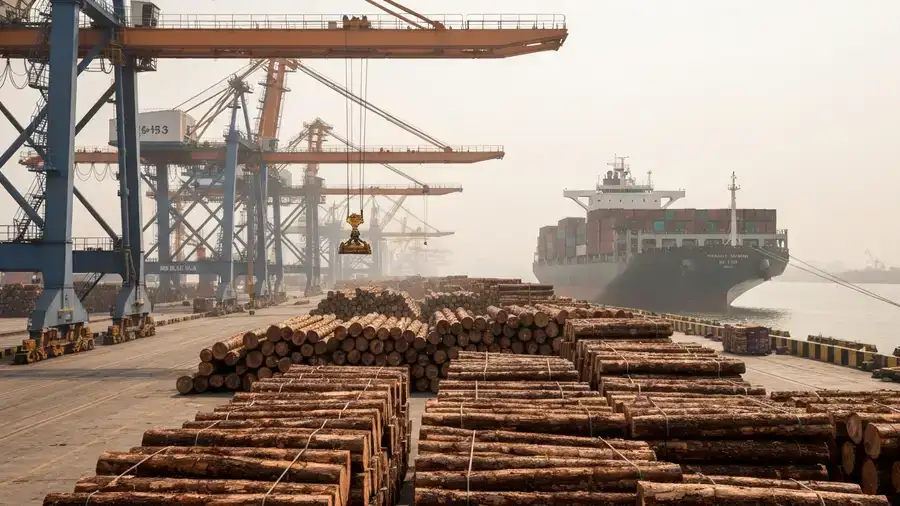
China, long a pivotal destination for international hardwood, remained a difficult market. The outlook drew on an April 2026 USDA market assessment that pointed to several headwinds at once: weaker global economic conditions, reduced exports of finished wood products, and changing domestic supply conditions all weighing on China’s hardwood market.
Two forces stand out for suppliers hoping to sell into China. First, construction-related demand there has softened, mirroring the broader global slowdown in building activity. Second, competition from domestically produced timber has increased, squeezing the space available for imports. Together, they mean international hardwood exporters face both a smaller pie and a larger local rival for the slices that remain. Shifting trade flows are reshaping the hardwood map more broadly, as seen in Vietnam’s rise as a hardwood supplier to the U.S., and the China picture is a central piece of that realignment.
Energy Costs and the EUDR Shift
Beyond demand, the outlook flagged two supply-side and regulatory factors worth watching. Higher energy prices were identified as a direct cost risk to forestry and forest-products businesses, which are energy-intensive across harvesting, transport, drying and milling. When energy climbs, margins compress even if product prices hold — a quiet but material threat in a low-demand environment.
On the regulatory front, the report noted that the European Commission completed its simplification review of the EU Deforestation Regulation, or EUDR, in May 2026. The EUDR has been a major compliance concern for wood products entering the European market, and any simplification of its requirements matters to exporters navigating due-diligence and traceability obligations. How the revised rules land will shape the cost and friction of selling into Europe, and it adds a layer of regulatory uncertainty on top of an already cautious demand picture. Producers weighing where to direct limited volumes must now factor compliance overhead into the calculus alongside price and freight.
Taken together, the Q2 2026 forest sector outlook is a study in patience. The near-term signals — costly credit, a soft China market and energy-cost risk — argue for caution, while the long-term fundamentals argue for staying the course. The report stops short of calling a turning point, but its framing implies that the current weakness is a trough to be managed rather than a permanent decline. For forest-products businesses, the message is to control costs and preserve flexibility through the cyclical downturn without losing sight of the structural demand that the outlook still expects to reassert itself once borrowing costs ease and construction recovers.