Boreal Crown Fires: Why They’re So Hard to Stop
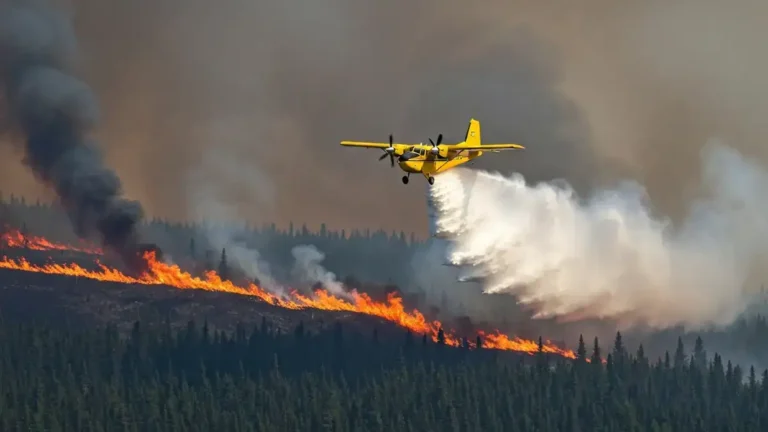
Every summer, as wildfires roar across Canada’s north, the same question fills social media feeds: why can’t water bombers just put them out? It is an understandable reaction to televised walls of flame. But when it comes to boreal crown fires — the high-intensity blazes that race through the tops of spruce and pine — the sheer physics of extreme fire behaviour can render standard suppression tactics practically useless. The reasons have less to do with firefighting effort and everything to do with the raw forces at play.
What Makes Boreal Crown Fires So Extreme
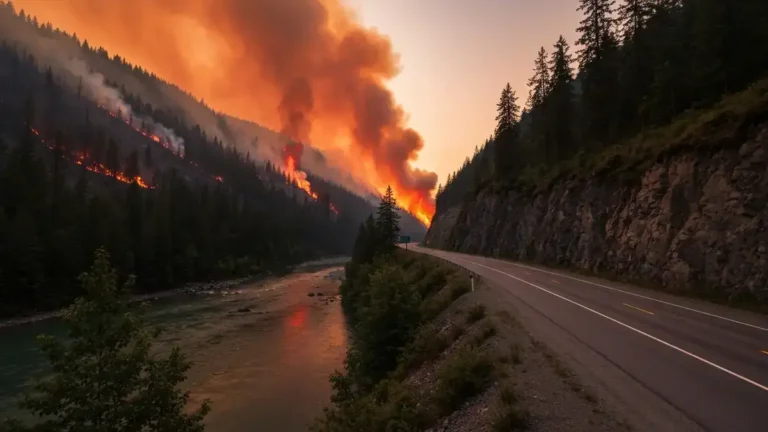
A crown fire is not a campfire scaled up. It is a fire that has climbed out of the surface litter and into the forest canopy, where it advances tree-to-tree with enormous speed and heat. In the vast, continuous fuel beds of the boreal — dense conifers loaded with flammable resins, over deep organic soils — a crown fire can generate immense thermal energy and travel remarkable distances across remote landscapes with no roads and no easy access for crews.
That combination is what defeats the intuitive fix. Air tankers do not “put out” large fires; at best, retardant and water slow a fire’s edge so ground crews can build containment line. Against a fully developed crown fire throwing embers ahead of itself, those drops can evaporate or be overrun in minutes. The problem is not that firefighters are doing too little — it is a fundamental conflict between limited human resources and the untameable physics of a fire-adapted ecosystem.
Fires That Make Their Own Weather
The most striking feature of extreme wildfires is that they can generate their own weather. Powerful updrafts loft heat, smoke and moisture high into the atmosphere, where they can condense into pyrocumulonimbus (pyroCb) clouds — thunderstorm-like columns that can tower 10 to 15 kilometres. According to ScienceAlert’s reporting on these fire-breathing storms, a pyroCb often produces dry lightning, chaotic winds and ember showers for miles around the fire.
That is a devastating combination for anyone trying to control a blaze. Dry lightning can ignite new fires well beyond the existing perimeter, while gusty, unpredictable outflow winds can flip a fire’s direction without warning and endanger crews. As Natural Resources Canada explains in its overview of fire behaviour, the atmospheric conditions an extreme fire creates can quickly overwhelm the limited wildland firefighting resources on the ground. The fire, in effect, writes its own forecast.
A Self-Sustaining Feedback Loop
What makes pyroCb events so hard to break is that they feed themselves. The cycle typically begins with intense surface heat drawing in surrounding air and forming a thermal bubble. That bubble rises as a convection column, which generates still more energy and makes the fire hotter and larger. If a cloud forms at the top of that column, its own buoyancy pulls harder on the air below — feeding energy back down into the fire in a self-reinforcing loop.
Once that engine is running, human intervention has little leverage. The scale of the phenomenon is not hypothetical: in the 2023 fire season, Canada recorded roughly 147 pyroCb events, an unprecedented frequency of these extreme fire episodes in a single year. Each one represents a fire that had, for a time, decoupled from anything crews could do to stop it — a reminder that the boreal’s biggest fires operate on an atmospheric scale.
The feedback loop also defeats the geometry of containment. Firefighting depends on building an unbroken line around a fire’s edge, but a crown fire under a pyroCb can loft burning embers — a process called spotting — hundreds of metres or even kilometres ahead of the main front. Every new spot fire becomes a fresh perimeter to chase, and when dozens ignite at once, the idea of a single line to hold simply dissolves. That is why crews often pull back to defensible ground and wait for the weather to change rather than confront the head of the fire directly.
Why Suppression Falls Short
Understanding all this reframes the “why don’t they just put it out” question. Suppression of massive boreal crown fires is not a story of inadequate response; it is a lesson in the limits of what any firefighting force can do against extreme fire behaviour, the contributions of a rapidly warming climate, and the realities of managing wildland fire across Canada’s remote north. Warmer, drier conditions lengthen the fire season and prime fuels to burn hotter, making the extreme days more common — a trend explored in coverage of why Canada’s northern fire seasons keep intensifying and how climate change is driving up wildfire risk.
That is why modern wildfire management leans so heavily on preparation rather than brute-force suppression: reducing hazardous fuels, hardening communities, and prioritizing crews where they can protect lives and property. Efforts to understand and treat wildfire fuel loads matter precisely because, once a boreal crown fire is making its own weather, the most effective work has usually already been done — long before the tankers ever take off.